
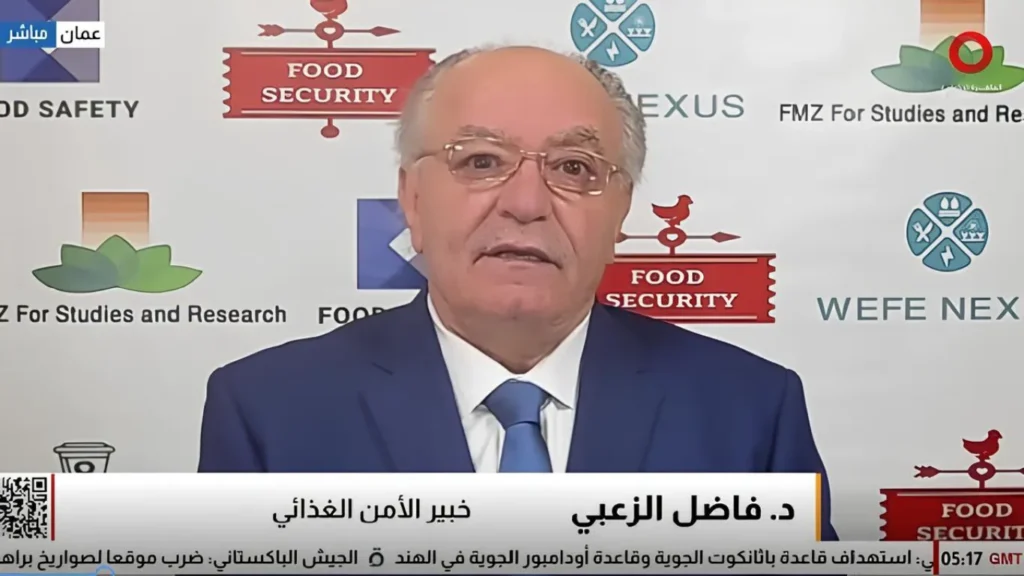
Dr. Fadel ELZUBI: Positive Indicators Reflect Stability of Jordan’s Food System
Food security expert Dr. Fadel ELZUBI told Al-Rai that Jordan’s agricultural and food sectors enjoy strong productive capacities that significantly reinforce national food security. Indicators show that local agricultural output covers more than 60% of total domestic needs by weight, reflecting a solid production base capable of meeting the bulk of local demand. This base is further strengthened by the contribution of local food industries, which supply over 50% of market needs — confirming genuine integration between agriculture and food manufacturing.
On the strategic reserve front, data reveal reassuring levels of essential commodities: wheat stocks exceed 12 months, barley more than 10 months, while oils, pulses, sugar, and other staples range between three and four months — a level considered moderate and safe by global standards. According to the Minister of Industry and Trade, strategic reserves of key goods cover three to twelve months, with daily monitoring of wheat, sugar, and oil levels, ensuring public confidence even amid regional conflict.
Jordan also achieves high self-sufficiency rates in strategic sectors: poultry at 98%, eggs at 97%, and dairy at 92%, securing market stability and shielding consumers from external shocks. In fruits and vegetables, local production meets over three-quarters of demand, with self-sufficiency in fruits at 75% and nearly 100% in fresh vegetables during peak seasons — underscoring diversity and abundance in domestic supply.
These indicators collectively highlight the resilience and flexibility of Jordan’s food system. National statistics show undernourishment rates at just 8.5%, child malnutrition under five at 3.2% — both better than global averages — and daily per capita calorie availability at 2,950, exceeding international benchmarks.
Jordan also produces a wide range of essential goods and has advanced protected agriculture, with greenhouse areas expanding by 40% in the past five years and grain production rising 25% in the latest season. Yet, Dr. ELZUBI emphasized that achieving food security requires a mix of self-reliance and regional integration, where local production ensures minimum needs while Arab cooperation diversifies supply sources and reduces risks.
On government policy, he noted efforts to stabilize prices despite transport costs rising by up to 200% on some routes. Measures include annual import support of JD 50 million, streamlined customs procedures through a single window, and concessional financing for importers backed by the Central Bank. However, he cautioned that using trade corridors as leverage in crises remains a challenge, calling for stronger international agreements to prevent their politicization.