
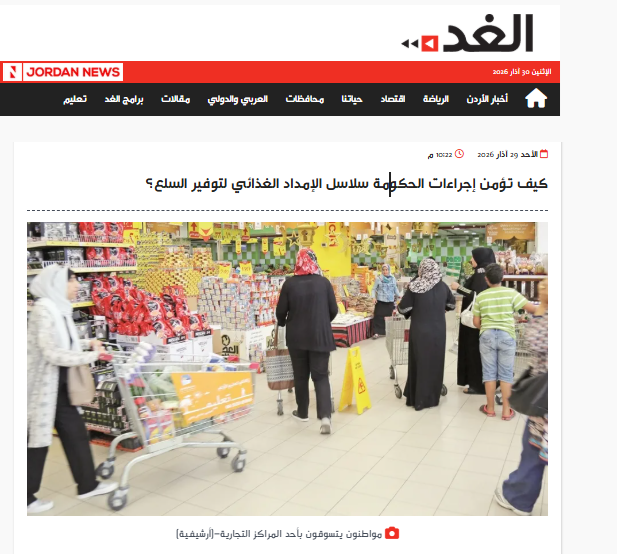
Food security expert Dr. Fadel ELZUBI stated that with the government announcing a package of measures to maintain the flow of food commodities to markets, all state institutions must integrate their efforts within this framework, with each ministry and agency assuming its responsibilities. The Ministry of Industry and Trade, for example, should expedite customs procedures when needed to facilitate the entry of essential food items at subsidized or duty‑free prices, while strengthening price monitoring to prevent monopolies and speculative practices that could trigger sharp increases in consumer goods. It must also ensure diversification of strategic import sources.
ELZUBI added that alternative markets or regional partnerships should be explored to secure wheat, sugar, and oils, maintaining safe reserves for emergencies. Ministries, in coordination with the Ministry of Finance, should be authorized to implement financial support or exceptional funding programs for local importers of essential goods, preventing shortages and containing inflation.
He emphasized that agricultural decision‑makers must enhance local food production capacity to offset potential import shortfalls and ease pressure on the food basket. This begins with supporting farmers by providing inputs at subsidized prices (seeds, fertilizers, equipment), protecting productive agricultural lands, and prioritizing food security as a national priority.
ELZUBI highlighted the need to expand intensive and hydroponic farming programs, especially for vegetables and fruits not widely grown locally, while encouraging household farming and cooperative production to increase supply. He also stressed the importance of modern storage and preservation systems—cooperative associations, sorting stations, cooling and storage facilities—and strengthening logistics chains between agricultural areas and urban markets to reduce waste and ensure rapid distribution.
Given water scarcity, ELZUBI called for immediate plans to improve water management in agriculture, promoting water‑saving technologies (drip irrigation, reuse of agricultural wastewater) and partnerships with water authorities to fairly allocate irrigation shares across regions. These measures, he explained, reinforce domestic food security and reduce reliance on external markets during import crises or global price spikes.
He further noted that the Ministry of Social Development bears responsibility for protecting the most vulnerable groups from soaring prices and rising living costs. This includes activating emergency social protection programs (such as Takaful or Tamkeen), increasing budget allocations for low‑income families, and distributing free or subsidized food baskets through provincial branches. Cooperation with municipalities and charities is also essential to ensure food distribution channels reach marginalized areas.
ELZUBI stressed that social development advisors must be present in pricing councils or relevant government committees to monitor markets, report immediately on the impact of price increases on target households, and propose urgent solutions (such as temporary food vouchers).
He concluded that the map of actors must include water and irrigation authorities as primary stakeholders, ensuring fair distribution and developing new projects for treated wastewater to sustain agricultural production. Planning and international cooperation agencies should also prioritize food security in donor dialogues, securing emergency funding and supporting non‑traditional agricultural research.
Finally, ELZUBI called for revising or eliminating taxes and customs duties on key agricultural and food inputs, while reassessing fiscal policy to ease macroeconomic pressures on prices. He emphasized that the close coordination of these institutions—industry and trade ensuring commodity flows, agriculture boosting domestic production, and social development protecting the vulnerable—can mitigate the crisis’s impact on citizens. Through integrated initiatives, Jordan can strengthen economic and social resilience against regional market fluctuations and safeguard the stability of the basic food basket.