
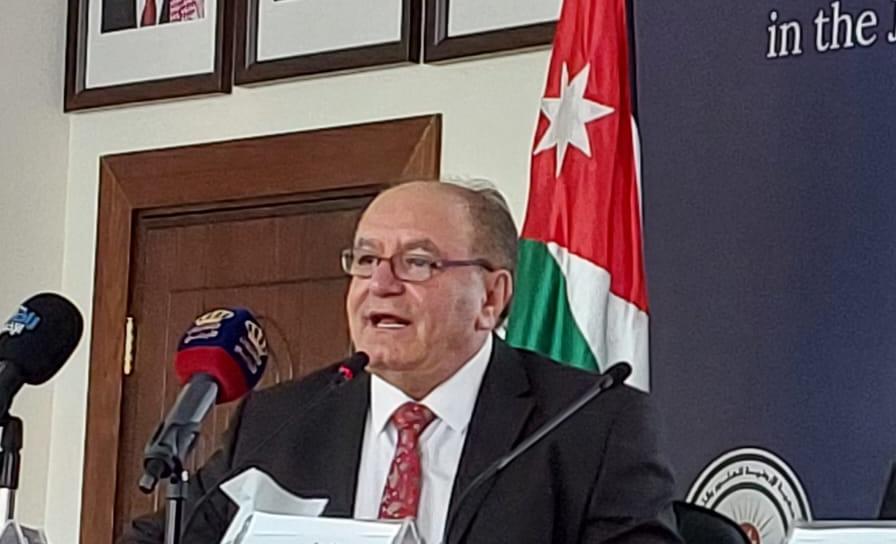
In this context, international food security expert Dr. Fadel ELZUBI observes that at a time when agricultural production is striving to evolve in order to increase its contribution to the gross domestic product, while also responding to numerous variables such as population growth, climate change, and the global pressure of rising prices, the strain on natural resources continues to intensify. Against this backdrop, the establishment of the Agricultural Security Investment and Industries Company emerges as a step that is expected to restore confidence in Jordan’s ability to safeguard its food security.
Yet the central question remains: are we truly facing a strategic investment, or merely a reproduction of the same traditional practices that led us into crisis? ELZUBI adds that the most critical challenge confronting this project is not the size of the land nor the type of crops, but rather the efficiency of water use—the scarcest resource in the Kingdom. There is no meaning in a massive investment that consumes thousands of cubic meters of water without accountability, while the real requirement is to focus production on the highest return in Jordanian dinars per cubic meter. Any project that ignores this equation is doomed to fail before it begins.
He explains that crop selection must be a precise response to market needs, whether for local consumption or for export, and not subject to mood-driven decisions or a continuation of past agricultural policies that flooded markets or wasted resources. What is required is for the company to become a platform for innovation and creativity, not a mere replica of outdated practices that have already proven ineffective.
ELZUBI stresses that if managed properly, the project could serve as a nucleus for similar initiatives in other regions, provided it is linked to serious scientific research, technical support, and accessible financing for small producers, while also involving farmers’ associations, universities, and research centers. In addition, launching a transparent system for marketing crops and connecting them to local and regional markets will determine whether the project becomes a national success story or just another missed opportunity.
He further emphasizes that food security is not a slogan to be raised at conferences, but a daily battle that requires sound governance, bold decisions, and genuine accountability. The current opportunity before the Agricultural Security Company is to prove itself as a strategic investment that places Jordan on the path to self-sufficiency, rather than simply becoming another headline for an old crisis. At the same time, conflicts of interest with farmers remain a pressing concern, as many fear that large-scale projects could turn into unfair competitors for small producers, undermining trust and weakening the very sector they are meant to support.