
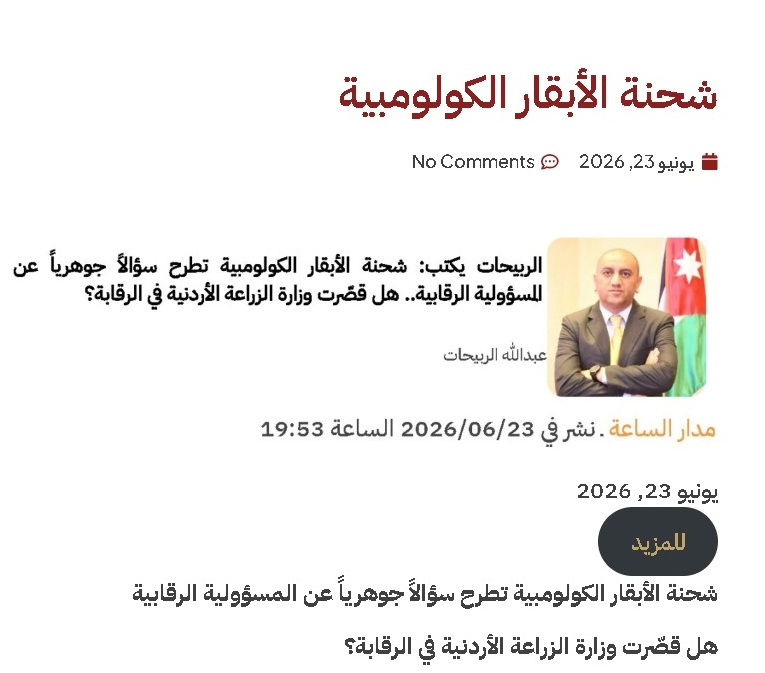
The Colombian Cattle Shipment Raises Fundamental Questions About Regulatory Responsibility
Did the Jordanian Ministry of Agriculture fail in its oversight?
A story has recently spread about a shipment of calves imported from Colombia that passed through Jordan in transit to Iraq. Upon arrival, Iraqi authorities examined the shipment and found it non-compliant and diseased, leading them to reject its entry. In an official response, the Jordanian Ministry of Agriculture confirmed that the shipment had obtained a transit license under current legislation, met all formal requirements, and was not intended for the local Jordanian market. Yet the more pressing question remains: does this absolve the Ministry entirely of responsibility, or were there international oversight obligations that were not fulfilled?
According to the Terrestrial Animal Health Code issued by the World Organisation for Animal Health (WOAH/OIE), transit passage is not an unconditional right for any shipment. It is subject to a set of controls that the transit country must verify before granting a license. Article 5.1.1 of the Code clearly states that the health status of the exporting country, the transit country, and the importing country must all be taken into account when defining trade requirements. This means Jordan was obliged to verify Iraq’s veterinary conditions before allowing the shipment to pass, not merely ensure compliance with domestic formalities.
In reality, the Colombian shipment was non-compliant with Iraq’s requirements and diseased. This raises a critical question: did Jordan fail to verify the shipment’s compliance with the final importer before granting the transit license? Was this a shortcoming in meeting the importing country’s conditions, and does it represent a fundamental failure in international oversight duties rather than a mere procedural formality?
The central issue concerns the actual veterinary inspection prior to granting the transit license. Article 5.4 of the Code stipulates that medical examination must confirm that animals are clinically healthy and consistent with the health status agreed upon between the exporting and importing countries. Did Jordan comply with this requirement? The fact that the disease was detected in Iraq suggests either that veterinary inspection in Jordan was not properly conducted before licensing, or that it was performed but failed to detect the illness due to inadequate competence. In either case, did the Ministry of Agriculture neglect to carry out a genuine veterinary inspection before authorizing transit?
There is also the matter of oversight during the transit period. Article 5.1.4 of the Code establishes a continuing ethical responsibility for the transit country if disease emerges during the incubation period after export. The Ministry declared that it “monitors the veterinary status of local and transit shipments” to safeguard animal health, but was this monitoring substantive or merely formal?
Did the Ministry fail to ensure that the shipment complied with Iraq’s requirements before transit, and fail to detect the disease until it was discovered in Iraq? The core question is whether the Jordanian Ministry of Agriculture is truly absolved, as its official response implied. While domestic procedures may have been correctly followed under Jordanian law, what about compliance with WOAH international standards? Was the veterinary inspection before transit insufficient, and was protection against disease spread ineffective? Does this reflect a regulatory shortcoming and incomplete adherence to international obligations, leaving the Ministry partially responsible for the problem?
The Ministry must clarify its compliance with Article 5.1.1 of the WOAH Code, which requires verification of the importing country’s health status before granting a transit license. Ultimately, this led to the passage of a diseased and non-compliant shipment—an outcome that cannot be dismissed as a mere procedural formality but rather constitutes a failure in international regulatory responsibility.
The Ministry of Agriculture has since announced that it will not allow the Colombian cattle shipment to re-enter Jordanian territory after Iraqi authorities confirmed the disease. This indicates that the shipment was already infected upon its initial entry into Jordan, raising serious questions about how it was permitted to pass into Iraq despite violating international transit standards. Such a lapse in enforcement raises genuine concerns about the potential risk of disease transmission to Jordan’s livestock sector during its first passage through Jordanian territory.