
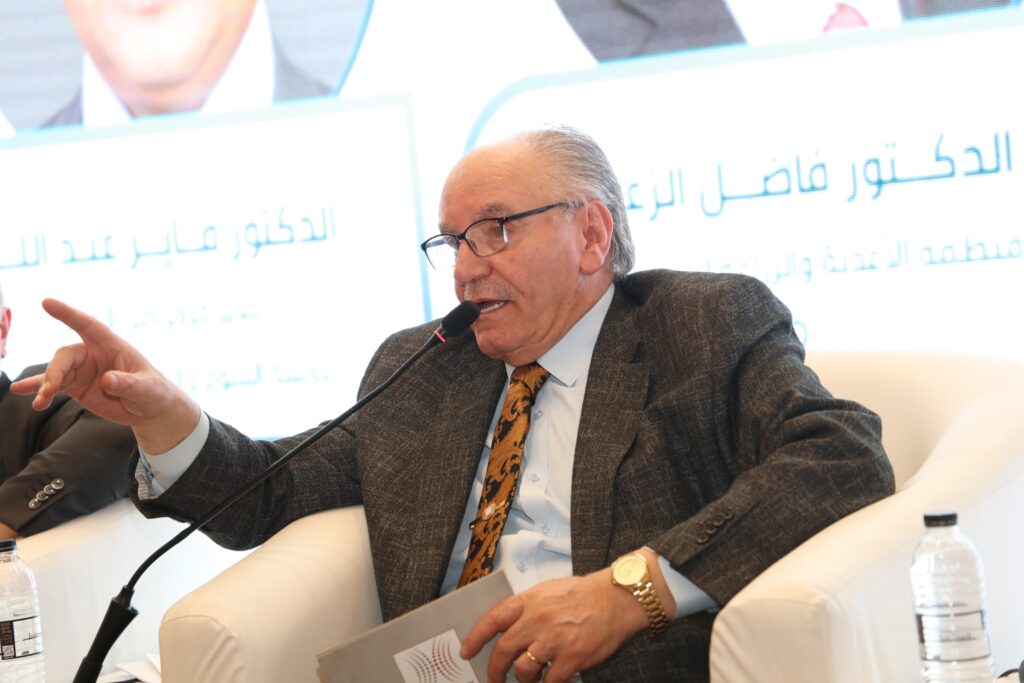
Dr. Fadel ELZUBI, food security expert, affirmed that the recent Royal directives to reinforce the strategic stockpile came at a critical moment, amid global climatic, geopolitical, and logistical disruptions affecting food markets and supply chains. He noted that the Ministry of Industry, Trade, and Supply has already begun implementing these directives, issuing on August 4 a report on the adequacy of the strategic reserves.
ELZUBI told Al-Rai that the risks to food security are no longer tied solely to global production volumes, but increasingly to the ability of commodities to reach markets, given maritime transport disruptions, rising shipping and insurance costs, geopolitical tensions, price volatility, and potential export restrictions by producing countries.
He explained that global experience shows food shortages often stem not from insufficient production, but from interruptions in commodity flows — whether due to port closures, shipment delays, or trade and financial bottlenecks.
ELZUBI emphasized that the strategic reserve is not a static balance but a dynamic process of consumption and replenishment, citing official figures that illustrate this reality. For example, in early July the actual wheat stock stood at 674,000 tons, covering 10.3 months including contracted quantities. By August 4, the actual stock was 610,000 tons, with overall coverage at 9.6 months. He stressed that this decline is natural and reflects normal monthly consumption of about 95,000 tons, underscoring that stock figures represent a “snapshot” of a moving system.
He argued that the key question is not “how much do we have today?” but rather “what is the relationship between withdrawal rates and replenishment speed?” A country with six months of reserves but the ability to replace shipments in two weeks may be safer than one with ten months of reserves but a three‑month procurement cycle.
ELZUBI called for shifting from measuring stock volume to assessing the readiness of the entire food security system — including replenishment speed, diversification of import sources, supply chain flexibility, private sector responsiveness, and logistical capacity in emergencies.
According to the Ministry’s report, wheat reserves currently cover 6.4 months, with an additional 302,000 tons contracted and en route, raising total coverage to 9.6 months. Barley reserves cover seven months, with 220,000 tons in transit adding 2.5 months, for a total of 9.5 months. Other commodities range between two and four months of coverage.
ELZUBI noted that while these figures are reassuring, a readiness‑based reading reveals deeper insights. For instance, one‑third of the declared wheat coverage remains outside the Kingdom, subject to logistical risks. He therefore distinguished between “sovereign coverage” — stocks physically inside warehouses — and “contractual coverage,” which materializes only upon arrival and storage.
He highlighted that Jordan’s food security system operates on two levels: government‑procured staples with coverage exceeding nine months, and privately imported commodities with coverage between two and four months. This variation reflects different procurement models rather than systemic weakness, but requires tailored risk management for each commodity.
ELZUBI stressed that the weakest link defines system readiness. If a major import gateway were disrupted for three months, wheat and barley levels would provide comfort, but sugar or vegetable oils could approach minimum thresholds.
He concluded that strengthening reserves has been achieved through coordination between the Ministry, chambers of commerce and industry, traders, importers, and the industrial sector, alongside ongoing monitoring of supply chains. He underscored that the true national reserve is the sum of public and private stocks, which must be visible to policymakers through a participatory data system linking regulators, importers, and industry.
Despite limited water resources and heavy reliance on imports, ELZUBI affirmed that Jordan has built a resilient food security system in recent years, grounded in proactive planning, forward contracts, diversified sourcing, private sector partnership, and continuous monitoring of global markets.