
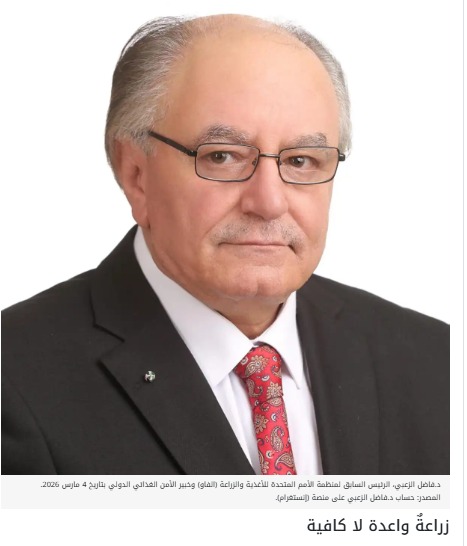
Food security expert Dr. Fadel ElZubi affirmed that Jordan currently enjoys a stable and moderate food situation, supported by proactive measures, strategic reserves, local production, and social protection networks.
In his interview with Sada Al-Shaab, ElZubi explained that the government has addressed the strategic stockpile issue for several years, implementing proactive measures that have proven crucial in crisis management. He noted that Jordan’s food basket is well-defined, starting with grains such as wheat and barley, with reserves exceeding ten months.
He emphasized that the importance of the strategic stockpile lies not only in quantity but also in enabling the state to absorb the initial shock of any global food market disruption—whether in prices or availability—providing Jordan with a safety margin lasting several months.
ElZubi added that Jordan produces over 62% of the food it consumes in vegetables and fruits, granting a high level of food security since local production does not rely on foreign supply chains or hard currency, thus mitigating global shocks.
He also highlighted Jordan’s extensive social protection network, which has successfully reached beneficiaries in recent years, forming a key pillar of stability in both the food and social systems.
ElZubi pointed out that Jordan is among the few countries with a Higher Council for Food Security, a national food security strategy, and a clear action plan, all integrated into the Economic Modernization Vision (2022–2033).
He explained that any sound economic vision must be built on three scenarios:
- The worst-case scenario, continuing business as usual, leading to slower growth and higher unemployment.
- The intermediate scenario, introducing partial improvements that yield limited growth.
- The optimal scenario, accelerating growth and increasing the contribution of productive sectors—particularly agriculture and food security—to boost employment rates in the coming years.
ElZubi stressed that food security is not an isolated sector but a multi-layered file linked to water, electricity, energy, and the environment, requiring cross-sectoral coordination. He noted that the world today focuses on the Water–Food–Energy–Environment nexus.
Regarding challenges, ElZubi said that climate change affects agricultural production, making reliance on rainfall alone unsustainable. He underscored the need to introduce technology into agriculture to help the sector absorb climatic shocks.
He explained that the challenge lies not in the lack of will or knowledge among stakeholders but in the cost of technology and the difficulty of adoption by small farmers—those owning 20 dunums or less, who represent over 80% of all farmers—making investment in modern agriculture or renewable energy difficult for them.
On supply chains, ElZubi noted that concerns about regional crises affecting Jordan’s food security are sometimes exaggerated, as Jordan’s main trading partner is Europe, and its import sources are diverse. He mentioned that meat comes from Argentina and Brazil, wheat from Romania and Bulgaria, and rice from multiple origins such as the United States and India, reducing dependency on any single route or source.
He confirmed that Jordan is close to achieving higher levels of food self-sufficiency, with local production reaching 130% for some vegetables, 80–90% for fruits, and 40% for red meat—up from 25% in previous years.
ElZubi referred to a study by the Economic and Social Council on the state of agriculture in Jordan, which identified three pillars for sector advancement:
- Organizing production to avoid market saturation and price collapse.
- Financing and technology integration.
- Governance.
He emphasized that the agricultural sector is the only one without a representative chamber, unlike industry and commerce, and that establishing a Jordan Chamber of Agriculture would strengthen organization and institutional representation for the sector.
Regarding citizens’ roles, ElZubi stressed the importance of raising consumer awareness, noting that unjustified hoarding stems from a lack of public education, which can lead to unnecessary panic buying and price hikes. He added that Jordanians are naturally cooperative when properly informed, calling for transparent communication and reassurance during crises.
On royal directives, ElZubi said that His Majesty the King has consistently issued clear and forward-looking messages on food security, both timely and substantive. He noted that while the state—government and private sector—has responded, efforts have not yet fully matched the level of royal guidance.
He added that the King has repeatedly called for supporting agriculture and food manufacturing, approving incentive packages and encouraging investment, recognizing the importance of food processing as a pillar of food security—especially in canning, extending shelf life, and reducing waste.
ElZubi concluded that the 2026 Food Security Report shows all indicators improving, confirming that Jordan’s food situation remains moderate and stable. He explained that price increases in certain items, such as tomatoes, are part of the broader food security system linked to production organization, not isolated indicators. He also noted that some areas still need more support and awareness.
Finally, ElZubi emphasized that global climate challenges remain significant and that rising food prices worldwide stem from multiple factors—such as droughts in North America and Australia and currency depreciation in exporting countries—rather than any single cause.