
ELZUBI to Sputnik on Food Waste

Is food waste a consumer behavior problem or a broken food system problem?
Food waste is not merely a consumer behavior issue; it is a problem affecting the entire food system.
The problem often begins with production, storage, and transportation, and continues through markets, restaurants, and households.
Therefore, it is not enough to simply ask consumers to avoid wasting food. Supply chains must be improved, legislation strengthened, and public awareness enhanced.
Real reform begins on the farm and continues all the way to the consumer’s table.
ELZUBI to Al-Rai: Promising Export Opportunities Require Market Diversification and Production Development

Dr. Fadel ELZUBI, an agricultural policy and food security expert at the Geneva Center for Studies and Research, stated that the strategy prepared by the Ministry of Industry, Trade and Supply in partnership with the Jordan Chamber of Industry, and supported by the Economic Reform Programme, goes beyond documenting the sector’s achievements. It identifies the challenges of the next phase, foremost among them the fact that part of the sector’s growth still relies on increased quantitative demand, making the enhancement of value addition a key priority.
https://alrai.com/article/10981912
He explained that the sector’s value added amounts to JOD 1.8 billion, representing approximately 40% of total production. This, he noted, calls for strengthening the local manufacturing of production inputs and better linking food industries with Jordanian agricultural production in order to increase the economic value generated throughout the production chain.
ELZUBI added that the fact that local products cover more than 62% of market needs does not necessarily mean that food self-sufficiency has been achieved, as several industries still depend on imported inputs such as sugar, cocoa, dairy derivatives, and packaging materials. He stressed the need to strengthen the relationship between agriculture and industry, develop products, and increase the share of locally generated value added.
Regarding exports, ELZUBI noted that the sector recorded cumulative growth of 102% over the past five years, with exports reaching JOD 823 million in 2024. However, he emphasized the importance of diversifying export markets, given that Saudi Arabia and Iraq account for a significant share of exports to the sector’s top ten markets during the period 2022–2025, with cumulative export values reaching JOD 607 million to Saudi Arabia and JOD 482 million to Iraq.
ELZUBI to QBC on Food Inflation and Foreign Exchange Reserves
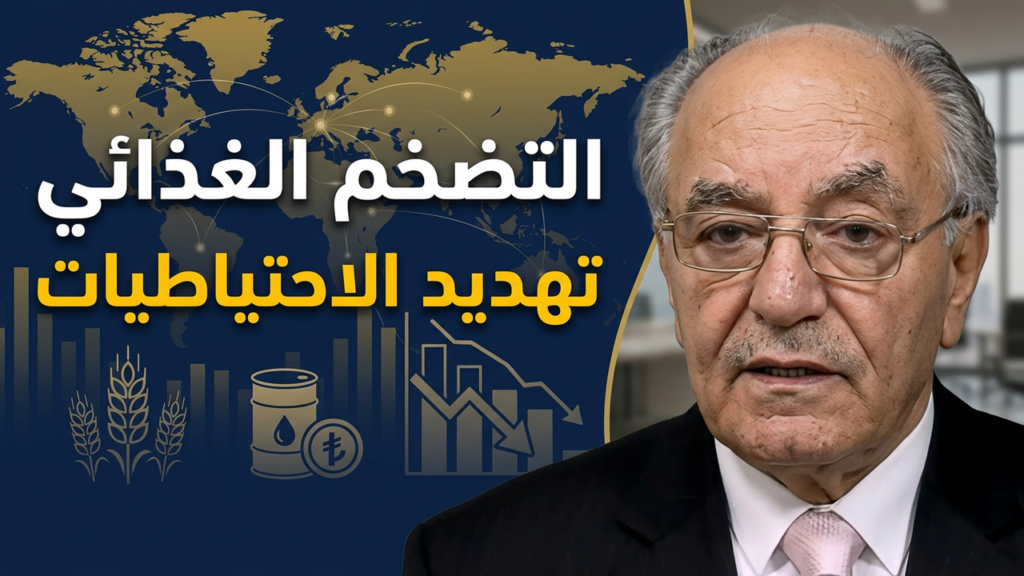
Rising grain and vegetable oil prices increase the import bill, thereby raising demand for foreign currencies.
The extent of pressure on foreign exchange reserves depends on several factors, including the value of imports, energy prices, exchange rate movements, and the level of available reserves.
ELZUBI to Asharq Bloomberg on Rising Wheat Prices

Why are wheat prices rising and concerns increasing?
Wheat is a strategic commodity, and any disruption to its production or export flows is reflected in global markets.
Russia and Ukraine are among the world’s largest wheat exporters, while the Black Sea remains a key corridor for global grain trade.
Conflicts, threats to shipping routes and port operations, as well as higher insurance and freight costs, are increasing price volatility.
Markets also react to anticipated risks, often before any actual shortage in supplies occurs.