
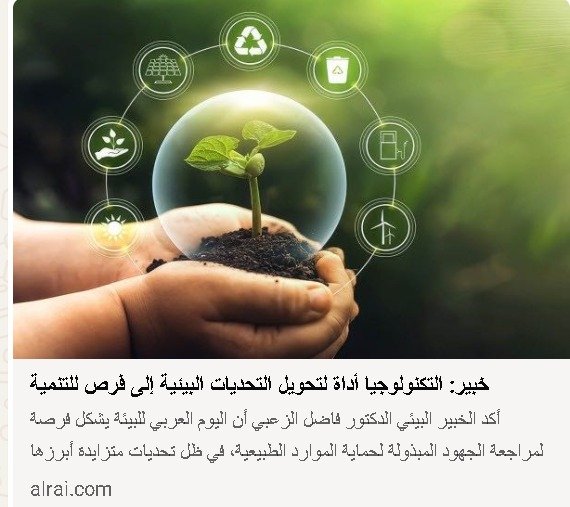
Dr. Fadel ELZUBI, environmental expert, affirmed that the Arab Environment Day represents an opportunity to review efforts to safeguard natural resources amid mounting challenges, foremost among them water scarcity, rising temperatures, desertification, and pollution. He stressed that protecting the environment is a collective responsibility directly linked to human health, food security, and the future of coming generations.
ELZUBI noted that concern for the environment should not be confined to an annual occasion, but must evolve into sustainable policies and daily practices—such as rationalizing water and energy consumption, reducing waste, and preserving natural resources. He highlighted that water scarcity and climate change intensify pressures on agriculture, accelerate land degradation, and threaten farmers’ livelihoods, while pollution of air, water, and soil, plastic waste accumulation, and biodiversity loss compound the risks.
He explained that the impacts of climate change are already tangible through rising temperatures, erratic rainfall, recurring droughts and floods, declining agricultural productivity, and higher food costs—disproportionately affecting low-income households and small farmers, as well as exposing coastal states to sea-level rise.
ELZUBI called for expanding clean energy use, advancing climate-smart agriculture, improving water management, strengthening oversight of industrial emissions, enhancing public transport, and safely reusing treated wastewater, alongside applying the “polluter pays” principle. He emphasized the importance of protecting biodiversity, restoring degraded lands, and preventing overfishing to sustain soil fertility, natural pollination, and agricultural productivity.
He underlined that governments bear responsibility for legislation, policies, and investment in environmental infrastructure, while citizens must contribute through responsible consumption, waste reduction, and recycling. Effective laws, services, and incentives are essential to drive behavioral change, without placing the burden solely on individuals.
ELZUBI also stressed the role of schools and universities in embedding environmental awareness among youth, integrating climate, water, and biodiversity issues into curricula, and supporting research and innovation in sustainable energy, agriculture, and water desalination. He pointed to the potential of satellite technologies, remote sensing, and artificial intelligence in forecasting droughts, improving irrigation, and monitoring crops, while smart meters and leak-detection systems can reduce water losses. Solar energy, recycling, and circular economy models can cut emissions and waste while creating jobs, provided that technology is affordable and research and startups are supported.
He concluded that achieving sustainable development requires integrated policies linking water, energy, food, and environment, with measurable indicators and accountability mechanisms. He stressed that environmental protection is a shared Arab cause that demands regional cooperation, urging industrialized nations to reduce emissions, provide climate finance, and transfer technology. Successful environmental policies, he said, are those that conserve resources, create jobs, and improve citizens’ lives. He called for transforming Arab Environment Day into a launchpad for continuous action that translates commitments into funded programs and tangible results, safeguarding the right of future generations to a safe environment and a dignified life.