
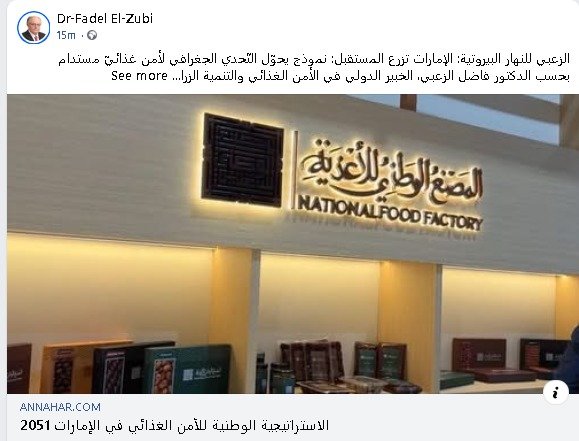
According to Dr. Fadel ELZUBI, international expert in food security, agricultural development, and post‑crisis recovery, and former Head of the FAO Mission in Iraq, the Emirati experience deserves a reading that goes beyond its promotional image of vertical farms and protein‑rich wheat. “Its true importance lies in building a system that combines smart local production, diversified imports, stock management, and the attraction of technology and capital.”
ELZUBI emphasizes that the most significant achievement is not visually striking projects, but the creation of a genuine framework for strategic hedging. “The strategy aimed to secure three to five alternative sources for each major food category, alongside developing systems for data collection, monitoring stocks, and tracking trade flows.”
Diversification of imports, strengthened reserves, and enhanced logistics enabled the UAE to mitigate shocks in global food markets and shipping routes — from wheat market disruptions after the Russia‑Ukraine war in 2022 to instability in the Red Sea and tensions around the Strait of Hormuz. The achievement, ELZUBI notes, lies in the system’s ability to absorb shocks and maintain supply continuity, not in abandoning external markets.
Local production also shows results. At Maliha Farm in Sharjah, wheat with a protein content of 19.3% was harvested and used in local food products under the “Seven Ears” brand. ELZUBI highlights the importance of linking scientific research with applied production and resource efficiency, offering expertise transferable to other desert regions, while recognizing each country’s different capacities.
Although projects remain at varying stages of planning and development, collectively they point toward positioning the UAE as a regional hub for food biotechnology. ELZUBI describes this path as “an engineered response to scarcity, rather than an attempt to replicate traditional agriculture’s resource consumption.”
Smart local production, diversified imports, strategic reserves, and cross‑border investment — this, ELZUBI explains, is the logic he sought to embed through his contribution to the Arab Food Security Strategy 2025‑2035, adopted at the Baghdad Development Summit in May 2025. “The Emirati model is worth studying not because it eliminated geographic challenges or achieved full self‑sufficiency, but because it developed more flexible and realistic tools to manage them.”
Drawing on his work in complex Arab contexts — from Iraq during the ISIS crisis to the Arab Food Security Strategy endorsed in Baghdad — ELZUBI concludes: “The honest answer is more complex, and more useful for the region, than the usual promotional image that reduces the Emirati experience to vertical farms and high‑protein wheat.”