
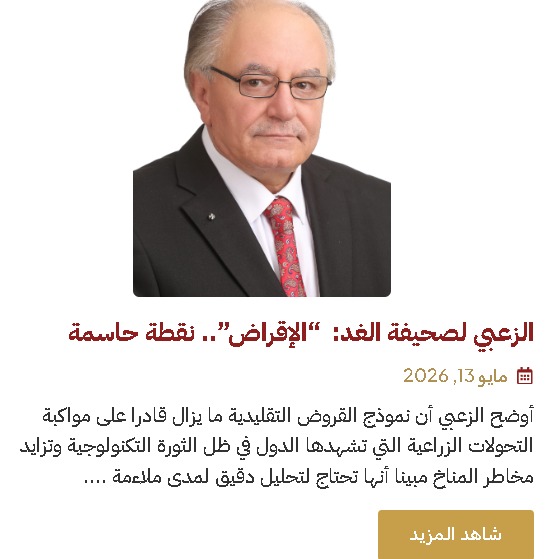
ELZUBI to Al-Ghad Newspaper: “Supporting Agriculture”… A Critical Point
International food security expert Dr. Fadel ELZUBI explained that in a country facing climate fluctuations, declining water resources, and increasing food security risks, the lending institution remains a decisive point in the equation of rural development and agricultural production.
ELZUBI questioned the institution’s ability to distinguish its financing needs from its banking desires and to adopt new financing models that are more efficient and realistic, with tangible impact on farmers and the sector. He emphasized that this requires a critical analysis balancing what is realistically possible against what remains a distant ambition.
He noted that the real bet lies in financing tools as a productivity lever, while paying attention to the necessary transformation in lending practices and agricultural policy updates. To judge the feasibility of new financing models, ELZUBI argued, they must be linked to indicators measuring sector dynamics and financing viability. In similar countries, agricultural loan default rates usually range between 8–15%, depending on the maturity of risk management systems, crop diversity, and efficiency of monitoring and evaluation mechanisms.
ELZUBI pointed out that default rates in some financing patterns in Jordan remain higher than the general banking average due to risks tied to seasonal production and the lack of accurate data on small and medium-sized farms. This calls for more flexible and tailored financial models.
He explained that agricultural production costs include inputs such as fertilizers, seeds, pesticides, and energy prices, all of which affect farmers’ ability to service debt compared to average production costs in key agricultural areas. Traditional financing structures, he added, require a deep understanding of value chains and their intersections with price fluctuations and production ceilings. While agriculture contributes 8–12% of GDP in some regional economies, its contribution in Jordan may be lower overall, yet it remains a vital pillar for food security and rural income. This necessitates separating costs from debt risks and building financing models that account for production variability, weather fluctuations, and global price changes.
ELZUBI highlighted the advantages of current agricultural lending, such as direct support programs for farmers, liquidity to purchase inputs during critical supply periods, and facilitation of essential operations like buying fertilizers, fuel, and irrigation. Lending also enhances production sustainability and resilience against environmental challenges through loans for projects improving irrigation efficiency, strengthening crop storage systems, and adopting more efficient crop technologies. Moreover, lending plays a role in establishing food security, creating rural jobs, and reducing rural poverty by linking loans to productive and economic projects.
He acknowledged structural criticisms, including slow administrative procedures and delays in converting approvals into actual financing, which undermine trust and reduce policy effectiveness. He also noted limited access for small farmers, as a large share of traditional loans still go to large landholders or through channels close to major banks, deepening inequality in financing distribution.
ELZUBI called for smart financing tied to production and technology, stressing that traditional models are bound by routine procedures that may not reflect actual production dynamics or mitigate climate risks. He emphasized the need for climate financing and modern agriculture approaches requiring climate risk assessments and financing guidelines that encourage investment in adaptation and emission-reduction technologies, vital within the green economy framework.
He proposed multiple models: production-linked financing, digital agricultural financing, climate loans, participatory financing, and loan-linked agricultural insurance. Production-linked financing, he explained, is concessional when tangible productivity indicators are available, defined precisely with experts, alongside performance tracking and interest rate adjustments based on crop productivity and management efficiency.
Digital agricultural financing, according to ELZUBI, is an integrated financial technology system allowing loan management via mobile apps and electronic platforms, enabling farmers to apply for loans, track financing status, and submit production reports—reducing transaction costs and enhancing transparency and access for small farmers.
Climate loans, he added, are preferential loans tied to climate adaptation and sustainability projects, providing measures to reduce weather risks by strengthening water reserves, improving irrigation techniques, and lowering agricultural emissions.
Participatory financing brings together local and international investors with farmers in partnerships that benefit both sides, offering farmers financing along with technical, technological, and training support through intermediaries that manage risks and fairly distribute profits. Finally, loan-linked agricultural insurance covers debt servicing in cases of crop loss or reduced production due to weather or pests, creating an additional safety margin for both farmers and lenders.
ELZUBI clarified that traditional loan models can still adapt to agricultural transformations under technological revolutions and climate risks, but they require precise analysis of loan conditions’ suitability for farmers’ backgrounds and total financing costs, including opportunity and time costs.
He stressed that financing alone is insufficient; it must be accompanied by production services, information, insurance, training, and marketing. Loans should shift from being seasonal burdens to genuine developmental tools, requiring shorter approval times and flexible models tied to agricultural growth stages that support sustainable production rather than single-harvest financing.
ELZUBI urged policymakers to strengthen governance and transparency frameworks by setting clear loan access criteria, documenting approval procedures, and publishing regular reports on loan portfolio performance, defaults, and compensation rates where insurance exists. He also emphasized the importance of independent oversight committees to build trust between farmers and banks, and the adoption of production-linked and digital financing models.
He concluded that empowering small farmers through transparent intermediaries, technical and training support, and participatory financing is essential. He cited regional experiences where innovative financing models reduced default risks and overall financing costs, with government agricultural banks adopting production-linked financing, continuous crop evaluation, and loan-linked insurance to stabilize farmers’ cash flows, lower defaults, and boost productivity.
ELZUBI stated that actual sector growth will reflect coordinated decisions and policies between financing and agriculture, integrating economic pillars with modern technologies and placing farmers at the center of rural development strategies. This, he said, is the realistic vision for the lending ambition required.